
Understanding Depression Signs, Support, and When to Seek Help
There are some days when you wake up feeling heavy. Like, when getting out of bed seems too difficult? When you are listening to your favourite song, and you do not feel that connection. Your friends whom you have known for most of your life appear like strangers. I'm not discussing having a bad day. We all have gone through bad days.
I am talking about something deeper that wraps your thoughts in a fog. It stays for around weeks or even months. Something that keeps on reassuring you that you are not good enough. Something that tells you that you are tired, and that things will not improve. Something clinical, persistent, and real.
And here's what makes it one of the most misunderstood mental health conditions. The person suffering from it is never seen; they are not always sad or crying. The person suffering from it appears normal. Every single day, they wear a smile while they are drowning from the inside.
Today, we have finally begun having actual discussions about mental health. The stigma cast on it is gently fading. Understanding depression is not just important. It is one of the most critical issues in today's society. As per the World Health Organization, depression is a real illness that is affecting more than 264 million people across the world. Millions of people work through this reality every single day in India alone. They are navigating this alone — and unsupported.
What Depression Is & Common Signs People Often Overlook
What Is Depression, really?
It is a medical condition that deeply impacts how we feel, think, and act, and how we are faring in terms of our physical health. Our brain has chemicals that are interconnected, forming a network. Neurotransmitters, for instance, like serotonin and dopamine, are said to be out of sync when one has depression. This altercation, coupled with a series of physiological and environmental factors, forms a state. A major change occurs in how a person begins to perceive their life as a whole.
Depression comes in different forms:
The American Psychiatric Association’s Diagnostic Statistical Manual of Mental Disorders, Fifth Edition (DSM-5) (credits) categorizes depression into several distinct types based on severity, duration, and onset.
| Type |
Key Characteristics |
| Clinical Depression (MDD) |
It has been described as a clinical condition of depressed mood, which brings along feelings of worthlessness, for at least two consecutive weeks, which often can cause considerable impairment in functioning. |
| Persistent Depressive Disorder (PDD) |
This has previously been referred to as dysthymia and represents symptoms of depression of a mild to moderate degree of long-standing duration of greater than two years, with persistent feelings of low mood and low energy. |
| Disruptive Mood Dysregulation Disorder (DMDD) |
Generally, it originates during childhood and is diagnosed, on average, before age 10. Kids with the condition experience unrelenting crankiness with explosive anger outbursts that are way out of proportion for their age. |
| Premenstrual Dysphoric Disorder (PMDD) |
It is explained as an intense form of premenstrual syndrome, which is defined by noticeable irritability and increased levels of anxiety and depression. |
| Peripartum Depression |
It has been divided into having a mood change occurring during pregnancy, referred to as prenatal onset, and having a postpartum onset within the first four weeks. |
| Seasonal Affective Disorder (SAD) |
It is often divided into episodes of depression that occur during the autumn or winter months and resolve or improve during the forthcoming spring or summer month and this is the seasonal pattern of mood disorder. |
| Atypical Depression |
It is described as a condition of mood reactivity. The temporary positive response to a positive stimulus, hypersensitivity to rejection, and an increased sensitivity to stressors in interpersonal relationships. |
| Depressive Disorder due to Medical Condition |
It is secondary to the physiological changes due to a variety of medical conditions (hypothyroidism and cardiovascular disease, etc.). |
Common Signs of Depression People Often Overlook
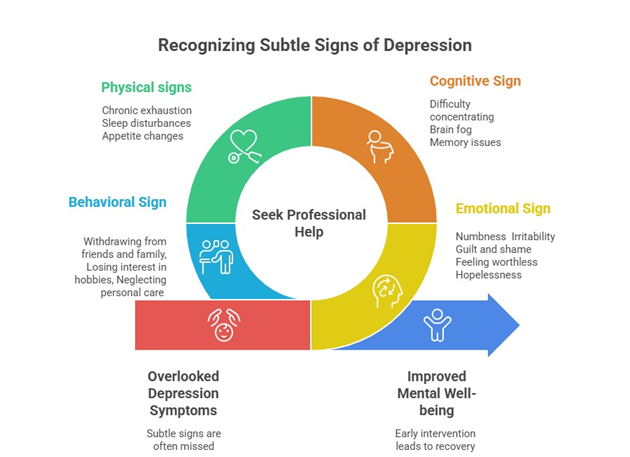
At Kaleidoscope, we understand that depression hides beyond tears: subtle emotional numbness, irritability, guilt; mental fog, lost motivation; physical fatigue, sleep/appetite chaos, aches; plus, withdrawal and neglected habits. It's not always dramatic—recognize these quiet signs to seek help early.
Why These Signs Get Missed
In India, mental health is stigmatized. People prefer not to discuss it openly. But it has been kept hidden behind the mask of strength and resilience.
- In hustle culture, burnout is normalized. Where people believe that burnout is normal behavior. People think that it is nothing to worry about.
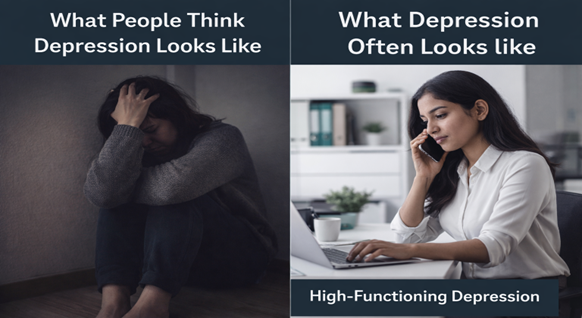
- High-functioning depression is kept hidden from most people. Parents, Managers, and the CEO are thought to be strong. Although they keep battling from within.
- The symptoms are confused with personality traits. Although they are symptoms of something more serious emotionally.
How Depression Can Affect Daily Life, Work, and Relationships
-
Daily Life Disruptions.
- Even the most mundane tasks of the day are seemingly unbearable, a huge mental drain just to get out of bed, brush your teeth, and make a meal.
- The routine we take for granted in daily activities starts to fade away as sleep cycle interruption, skipping of meals, and neglect of one’s body become the order of the day because of the unavailability of both physical and emotional energy.
- It seems like moving and thinking are too slow and difficult, and this causes you difficulties in performing activities, while others are performing the activities with ease.
- This leads to a vicious cycle of a bad state of mind that breeds guilt, guilt that breeds inertia, and so on.
-
Impact on Work and Professional Life
- There is a decrease in concentration to a great extent, and the absence of the ability to get things done by being unable to start and get involved in projects that were possible and exciting.
- Productivity levels will dip, and there will be instances of missed deadlines and absenteeism. This is because, while they might be reporting to work physically, they will not reach the same comfort level.
- Chronic self-doubt flourishes, and inner criticisms and the threat of failure overwhelm what is real and what is obscure.
- The fear of judgment and feelings of inadequacy might build up and remain silent, avoiding communication, and consequently impact career progression in the long run.
- If this is left unmanaged, the depression could affect the performance of employees worldwide, leading to an unprecedented loss for the world. At kaleidoscope we have helped people fight depression and achieve their maximum output.
-
Relationship Ruptures
- When social withdrawal starts to manifest in a human being, they stop their social arrangements and conversations, and in some instances, they may be subjected to the reality of being dumped by their significant others due to emotional exhaustion.
- They define their inner emptiness as hard to express in words. Their close family members and friends’ experiences may be misunderstood and confused, causing them to become numb.
- This may result in irritation or numbness, and relationships are torn apart as the partner, friends, and family feel like they are not connected to the individual.
- With this in place, depression forces the depressed to seek solitude at a time when they should be receiving the greatest support.
| Life Area |
Visible Effects |
Hidden Inner Struggle |
| Daily Routines |
Skipped grooming, erratic eating/sleeping patterns |
Basics feel insurmountable; energy remains drained |
| Job Output |
Sloppy work, missed days, productivity dip |
Brain haze blocks focus and clear thinking |
| Social Ties |
Pulling away, dodging people, more tension |
Convinced you're a drag, emotionally numb |
| Body Wellness |
Endless tiredness, sleep woes, mystery pains |
Perpetual drag, zero spark in your step |
| Self-Image |
Ignoring looks, dropping duties |
Harsh inner judge erodes your self-value |
Healthy Coping Techniques.
These techniques complement and in no way replace professional mental health care. Used in harmony with therapy and medical care, they provide optimal conditions for healing.

-
Establishing a Gentle Daily Routine: Additionally, depression leads to the breakdown of a structure that can be improved with a daily framework that is both gradual and gentle. Discipline in observing proper sleeping hours is an important aspect of regulating mood, and consuming small amounts of healthy meals is key to supplying the brain with energy that it doesn’t have naturally, as the brain relies on energy from outside in its day. Walking or stretching reduces and relieves the problem of negative thoughts.
-
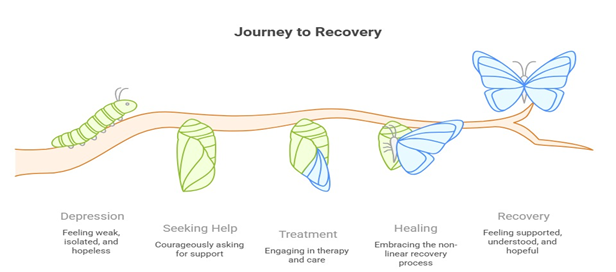
Seeking and Accepting Support: People who are suffering from mental health issues are ashamed of asking for help. On the other hand, looking for help from friends, trusted friends, or family who have experienced similar problems will open new possibilities of relief. To directly ask for assistance is, in fact, very much an act of strength as opposed to weakness. Being open to help adds richness to interpersonal experiences. At Kaleidoscope, we have provided support to people seeking it.
-
Rest, Recovery, and Self-Compassion: Today’s prevalent culture focuses on the myth that people are idle or lazy if they are at rest. Still, none of us seems to get that rest is a state that contains reparation. The fatigue that a person experiences when experiencing mental depression is one of the manifestations of biological tension on the body, and it is therefore a question of a lack of strength. That’s a sign that the person is getting more settled. Self-compassion is treating oneself with kindness that you would show towards another person.
-
Healthy Emotional Expression: Silence strengthens depression; journaling helps release emotions and understand thoughts clearly. Writing down thoughts in a journal allows thoughts to change from an internal cycle to a written experience, which promotes understanding. Mindfulness will calm the angered mind. Sharing what we are feeling will reduce the strength of emotion.
The purpose is about processing feelings instead of eliminating depression. Expression helps in providing room for feelings without being overwhelmed by them.
Importance of Therapy, Counseling, or Medical Help
When to Call Professionals
If episodes of the former symptoms persist for at least two weeks, are sufficient to disrupt the ability of the afflicted person to function, or involve hopelessness or the patient contemplating suicide by drug and alcohol, then intervention of professionals is very important. This prevents depression from going beyond the limits and markedly increases the rate of improvement in patient recovery.
Therapy and Counseling
Therapy is a safe place where one can examine, for example, negative thoughts, emotional triggers, ways of coping with stress, etc. And in that context, therapies like CBT, Interpersonal Therapy, etc., certainly are effective, but at a slow, steady clip.
Medical and Psychiatric Support
Medications may also be required for the stabilization of the biological system if depression is moderate or severe. Many treatments can cure depression. Overall, combining treatments provides more rapid and wider relief, particularly for cases resistant to treatment.
How Kaleidoscope Helps Individuals Deal with Depression
The first step to your emotional wellness is to seek the right counseling service, and Kaleidoscope is a reliable psychological wellness provider that offers counseling that is not only supportive but also result-oriented for those dealing with depression and other issues. What makes Kaleidoscope unique is a few aspects.
-
We Have Mental Health Professionals: When you turn to us, we have professionals who are trained in how to deal with depression and emotional issues.
-
We apply a root cause-focused approach. In this case, the therapy offered is more profound than the alleviation of symptoms. It includes emotional, cognitive, and behavioral aspects.
-
We have individualized Care Plans: The plan of individualized counseling is personal to every individual according to their emotional needs, lifestyle, and experience.
-
Kaleidoscope is a Safe and Non-Judgmental Space: The client will be able to share freely in a safe, non-judgmental space.
-
We support everyone in their emotional healing, and balancing brings resiliency and finally emotional stability.
Kaleidoscope assures you that there is hope for healing, self-discovery, and mental renewal through treatments for depression.
👉 If you want to avail yourself of the specialized counseling offered by Kaleidoscope, you can visit their website and take the first step towards mental wellness today.
Medical Disclaimer: The information provided in this blog is for general information purposes only and is not intended as a substitute for medical judgment. You should always consult with your physician or other qualified medical health provider if you have any questions about a medical condition or mental health issue.

 Life-O-Scope
 anxiety
 depression
 stress
 trauma
 ADHD
ADHD OCD
OCD bipolar disorder
 schizophrenia
 Autism Spectrum
 Learning Disabilities
 Care Programs