According to the American Psychiatric Association, Attention-Deficit/Hyperactivity Disorder is defined as a common neurodevelopmental condition. It affects both children and adults.
Do you find it difficult to stay focused, even on tasks that are important to you?
Do you get distracted easily or struggle to finish what you start?
Do you often feel restless, impatient, or find it difficult to sit still?
Do you act quickly, interrupt others, or make decisions without thinking them through?
ADHD is often misunderstood. This is especially true in India. Many people see ADHD as bad behaviour. Others see it as laziness or hyperactivity. However, ADHD is a neurodevelopmental condition.
ADHD often runs in families. ADHD does not look the same in everyone. Some adults receive a diagnosis in their thirties. Others receive a diagnosis in their forties. Many people finally understand why certain tasks have always felt difficult.
You may have struggled with things that seem easy for others. If this feels familiar, learning more about ADHD may help.
ADHD can look different in every child, teenager, and adult. However, some signs are more common.
Missing details in work.
Struggling to focus on tasks.
Appearing distracted when directly addressed.
Failing to follow through on instructions.
Struggling with time management and schedules.
Frequently misplacing keys, phones, or papers.
Missing daily chores, errands, or appointments.
In case of emergency you can always reach out to 24/7 crisis helplines
Constant squirming, tapping, or foot-shaking.
Inability to stay seated when required.
Running or climbing inappropriately (or mental restlessness in adults).
Inability to play or relax quietly.
Acting as if "driven by a motor".
Speaking continuously without pausing.
In case of emergency you can always reach out to 24/7 crisis helplines
Speaking before a question is finished.
Extreme difficulty waiting for a turn.
Intrusion on conversations or games.
Acting immediately without thinking of consequences.
In case of emergency you can always reach out to 24/7 crisis helplines
Many people with ADHD learn to hide their difficulties. This is known as masking. Masking is especially common in women. It is also common in people with inattentive ADHD.
Some people spend years working harder than everyone around them. Others constantly push themselves to keep up. This effort often goes unnoticed. However, the exhaustion is important. It may be a sign that ADHD is affecting daily life.
ADHD exists on a spectrum. ADHD affects people differently. Some people experience mild difficulties. Others experience challenges in many areas of life.
Professional assessment may be helpful if:
Symptoms have been present since childhood.
Severe behavioral struggles occur consistently across both home and public environments.
Frequent, severe personal conflicts arise due to poor listening and forgotten commitments.
Reckless, heat-of-the-moment decisions lead to injury, debt, or legal issues.
Chronic anxiety, daily overwhelm, and burnout make it difficult to cope.
Basic routines, sleep, hygiene, or organization are consistently difficult to maintain.
Critical deadlines are frequently missed or tasks at school or work remain incomplete.
Many people seek support after receiving a diagnosis. Others want to help manage daily challenges. Therapy can support both goals. You may have wondered for years why certain things feel harder for you. A formal assessment can provide clarity. It can also help you understand your experiences.
Recognizing ADHD reminds us that these daily challenges are not a reflection of a person's effort, character, or choices.
ADHD often runs in families. Genetics plays a major role in its development. Research shows that ADHD is highly heritable.
Many children with ADHD have a parent with ADHD.
Research has also identified differences in the ADHD brain. These differences affect areas involved in executive functioning. Executive functioning helps with planning. It also supports organisation. In addition, it plays a role in attention and impulse control.
ADHD is a brain-based condition. It is not a choice. It is not a phase. It is not caused by a lack of effort.
While genetics plays the largest role in ADHD, some factors during pregnancy and birth may increase the likelihood of ADHD.
These include exposure to tobacco, alcohol, or certain substances during pregnancy. Premature birth may also increase risk.
Low birth weight is another recognised risk factor. Some complications during birth may also play a role.
The environment does not cause ADHD. However, it can affect how ADHD shows up in daily life.
High levels of stress can make symptoms worse. Early adversity can also increase difficulties. Trauma may have a similar effect.
Some children struggle in environments that require long periods of sitting still. Others find it difficult to stay engaged in settings with little stimulation.
Supportive environments can make a significant difference.
ADHD often occurs alongside other conditions. Therefore, it is important to understand the full picture. Treating ADHD alone may not address every difficulty.
1. Anxiety Disorders
Anxiety is common in people with ADHD. Anxiety can affect concentration. It can also cause restlessness. As a result, anxiety and ADHD can sometimes look similar. A careful assessment can help identify the difference.
2. Depression
Depression is more common in people with long-undiagnosed ADHD. Years of struggle can affect self-esteem. Repeated criticism can also affect mood.
3. Learning Differences
Dyslexia, dysgraphia, and dyscalculia often occur alongside ADHD. A comprehensive assessment can identify these difficulties.
4. Oppositional Defiant Disorder (ODD) and Conduct Disorder
These conditions are more common in children with ADHD. This is especially true when ADHD has gone untreated for a long time.
5. Autism Spectrum Disorder (ASD)
ADHD and autism can occur together. The two conditions share some similarities. Therefore, a thorough assessment is important.
6. Substance Use Difficulties
Adults with undiagnosed ADHD may be at greater risk of substance misuse. Some people use substances to cope with emotional difficulties. Others use them to manage restlessness or boredom.
A thorough psychological assessment at Kaleidoscope will evaluate co-occurring conditions and ensure the treatment plan addresses the full picture, not just the ADHD in isolation.
Book an online appointment for expert care anytime, anywhere.
ADHD is divided into three presentations. However, symptoms can change over time. Some people also show features of more than one presentation.
This presentation is often less noticeable. People may appear quiet or distracted. Many struggle with attention. Children with this presentation are often overlooked. This is especially true when they are not disruptive. They may be described as dreamy. Others may describe them as forgetful or scattered. Many adults with inattentive ADHD are diagnosed later in life.
This presentation is marked by hyperactivity and impulsivity. People may find it difficult to sit still. This presentation is often recognised during childhood. Hyperactivity may become less visible with age. However, many adults continue to experience inner restlessness.
This is the most common presentation. People experience symptoms of inattention. They also experience symptoms of hyperactivity and impulsivity.
ADHD presentations are not fixed. Symptoms often change over time. Therefore, a thorough assessment is important. An ADHD assessment at Kaleidoscope looks at current symptoms. It also considers experiences across the lifespan.
A thorough assessment is the first step. It helps determine whether ADHD is present. It also helps identify the type of ADHD. In addition, it helps identify other conditions that may be affecting daily life.
Our ADHD assessment includes a clinical interview, standardised rating scales, and cognitive testing when needed. It also considers other conditions that may affect attention and behaviour. A detailed report is provided with findings and recommendations. For many people, the assessment brings clarity and helps explain years of unexplained difficulties.
Understanding ADHD is an important part of treatment. Many people spend years wondering why certain things feel more difficult for them.
Learning how ADHD affects attention, motivation, organisation, and emotions can provide clarity. For many adults, an ADHD diagnosis helps make sense of years of self-doubt and frustration.
Parent training is one of the most effective supports for children with ADHD. It helps parents understand ADHD as a neurodevelopmental condition and provides practical strategies for daily life.
Parents learn how to create structure, build routines, manage emotional outbursts, and support positive behaviour.
Many adults with ADHD need more than insight alone. They also need practical systems that work in daily life. ADHD coaching focuses on these skills. It can help with organisation, planning, prioritisation, financial management, and daily routines.
At Kaleidoscope, coaching is provided by psychologists who understand ADHD. The goal is not to force a system that works for everyone else. Instead, the focus is on building strategies that work for your strengths, challenges, and daily needs.
Mindfulness can be helpful for people with ADHD. It helps strengthen attention. It can also improve awareness of thoughts and distractions.
Over time, people learn to notice when their attention has drifted. They also learn how to gently bring their focus back. Mindfulness for ADHD is adapted to the needs of people with ADHD. Practice is often shorter. Some exercises include movement. The focus is on progress rather than perfection.
ADHD treatment is different from standard CBT. It is designed specifically for people with ADHD. It focuses on the practical difficulties that ADHD creates in daily life. Therapy focuses on practical ADHD skills.
It can help with organisation and planning. It can also improve time management and reduce procrastination. In addition, therapy can help build confidence and make daily tasks feel more manageable. Many people continue to benefit from these skills long after therapy ends.
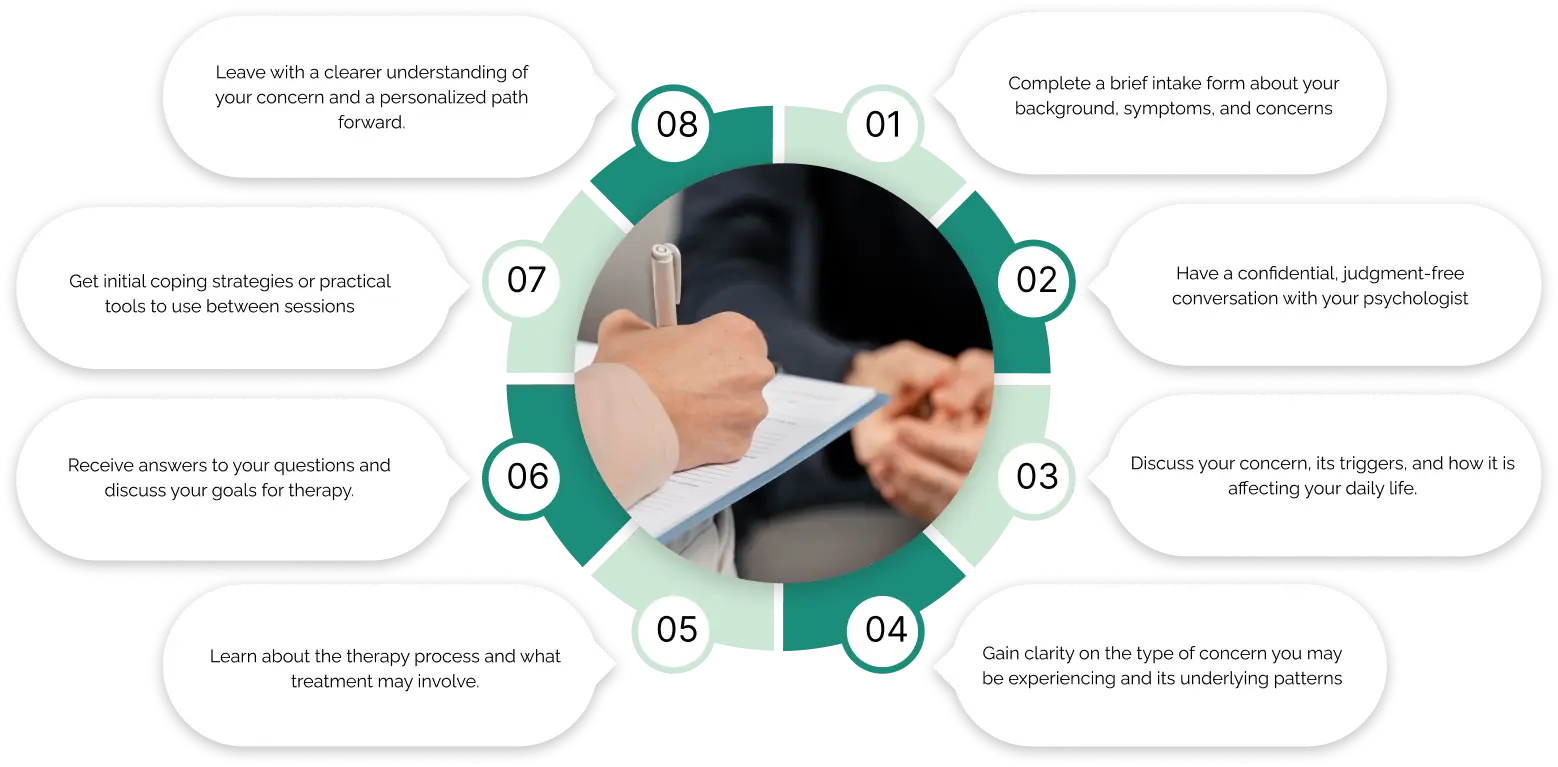
The first appointment helps your psychologist understand your concerns and decide on the next steps. It also allows you to ask questions and gain clarity about the assessment or therapy process.

For children, the process may include time with both parents and the child. After the session, your psychologist will explain the plan and any recommended next steps.
Both mode are clinically effective. Research consistently shows that online therapy produces outcomes equivalent to in-person therapy for your concerns. The best format is simply the one that makes it easiest for you to show up consistently.
Have A Question Or Need Support? Share Your Concerns With Us and Our Experts Will Help You Take The Next Step Toward Better Health.