According to WHO, Autism spectrum disorder (ASD) is summarized as a “group of neurodevelopmental conditions characterized by persistent deficits in the ability to initiate and sustain reciprocal social interaction and social communication and by a range of restricted, repetitive, and inflexible patterns of behaviour, interests, or activities.
Does your child not respond to their name, or show little interest in other children their age?
Have you noticed repetitive movements, rigid routines, or intense distress when plans change?
Does your child, teenager, or you yourself find social situations confusing, exhausting, or hard to read?
Are there strong sensory sensitivities to sounds, lights, textures, crowds that affect daily life?
Autism can be identified at any age. Some children show clear signs in the first two years of life. Others are not recognised until school age or adolescence. Many adults only receive a diagnosis in their thirties, forties, or later.
If you process the world differently, deeply, intensely, or in ways others don't always understand, If you've ever felt like you're missing a manual everyone else was given. You are in the right place.
Autism presents differently depending on age, ability level, and individual personality. These are the signs that are most commonly observed
Not responding to their name by 12 months; limited babbling, pointing, or waving
No single words by 18 months, or no two-word phrases by 24 months
Loss of previously acquired language or social skills at any age
Avoiding eye contact or showing little interest in faces and people
Repetitive movements such as hand-flapping, rocking, or spinning
In case of emergency you can always reach out to 24/7 crisis helplines
Difficulty making or keeping friends despite wanting connection
Trouble understanding unspoken social rules, sarcasm, or facial expressions
Intense, narrowly focused interests that dominate much of their time and attention
Strong preference for routine and significant distress when it changes
Sensory sensitivities that interfere with school, meals, or everyday activitiess
In case of emergency you can always reach out to 24/7 crisis helplines
A lifelong sense of being different without a clear explanation
Social exhaustion after interactions that others seem to find effortless
Challenges with planning, organising, or managing changes
Difficulty identifying or expressing emotions
A pattern of relationships and workplaces that have not worked out, without understanding why
In case of emergency you can always reach out to 24/7 crisis helplines
If some of these signs feel familiar, you are not alone. You can take the next step and finding the right support can make all the difference.
Seeking an assessment is the right step when
A professional has raised concerns: A teacher, paediatrician, or speech therapist has flagged something and recommended follow-up.
Developmental milestones were missed or lost: Your child did not reach key communication or social milestones, or lost skills they previously had.
An existing diagnosis does not feel complete: Your child has been diagnosed with anxiety, ADHD, or a learning difficulty, but something still feels unexplained.
Daily life is significantly affected: Social situations, sensory environments, or routine changes are causing consistent distress or avoidance.
You simply want clarity: A thorough assessment either confirms ASD or rules it out. Both outcomes are useful. Both give you something concrete to work with.
There is no such thing as seeking answers too early or too late. Understanding is always the right next step.
Stress rarely comes from just one place; it accumulates quietly over time. Let’s look at the common roots and causes of stress together, not to label your struggles, but to help you find a clearer path toward relief and emotional balance.
Research has identified hundreds of genes associated with an increased likelihood of autism. In many cases, these genetic differences are inherited. In others, they arise as new variations with no prior family history. Having a sibling or parent with ASD increases the statistical likelihood, but autism frequently occurs in families with no previous diagnosis.
Brain imaging research consistently shows that autistic brains are structured and connected differently from neurotypical brain, particularly in areas governing social cognition, sensory processing, language, and executive function. These are not deficits to be corrected. They are differences, many of which come with genuine cognitive strengths such as pattern recognition, deep focus, and attention to detail.
Book an online appointment for expert care anytime, anywhere.
Autism is not a singular experience; it is a wide and varied spectrum. Understanding how it shows up for you, or your child, is what makes the real difference.
This describes autism at a more intense level, with stronger challenges in communication, behaviour, and social interaction. It requires more support than Asperger's or PDD-NOS, but every individual's experience is still unique.
This was used when someone showed clear signs of autism but didn't fit neatly into any single category. It sat in the middle of the spectrum. More pronounced than Asperger's, but less so than classical autism.
Often seen as the milder end of the spectrum, people with Asperger's are frequently intelligent and capable in daily life. Their biggest challenges tend to be social, such as reading people, fitting in, and navigating social cues.
The rarest form on the spectrum, where a child develops normally for the first few years and then loses previously gained skills, including language, social ability, and communication. It typically emerges between the ages of two and four.
There is no single approach to autism support. At Kaleidoscope, we begin with a thorough assessment to understand the individual's specific profile — their strengths, challenges, sensory needs, communication style, and personal goals. Everything that follows is built around that.
Our therapist for autism is trained across multiple evidence-based approaches. Depending on the individual's age, presentation, and what matters most to them and their family, your therapist may draw on one or more of the following:
A thorough, multi-session evaluation covering developmental history, behavioural observation, and cognitive, language, and sensory functioning. The process concludes with a detailed written report including diagnosis, a functional profile, and specific recommendations.
Sensory sensitivities to sound, light, touch, and movement are among the most disruptive — and least visible — aspects of autism. We help individuals identify their sensory profile and develop practical strategies to reduce distress at school, at work, and in social settings.
Parents and caregivers are partners in therapy, not bystanders. We translate clinical techniques into everyday strategies so that progress made in sessions is reinforced and extended at home, at school, and in the community.
Social interaction does not always come intuitively to autistic individuals — not because connection is unwanted, but because unspoken social rules often need to be explicitly taught. Sessions focus on conversation, reading body language, managing conflict, and building lasting friendships.
One of the most researched therapeutic approaches for autism, ABA works by understanding the relationship between behaviour and environment to teach new skills. At Kaleidoscope, it is naturalistic and play-based, always guided by the individual's own goals.
Adapted in pace, structure, and communication style, CBT is highly effective for the anxiety, low mood, or emotional dysregulation that often accompanies autism. It helps identify unhelpful thought patterns, build coping strategies, and manage the emotional weight of everyday life.
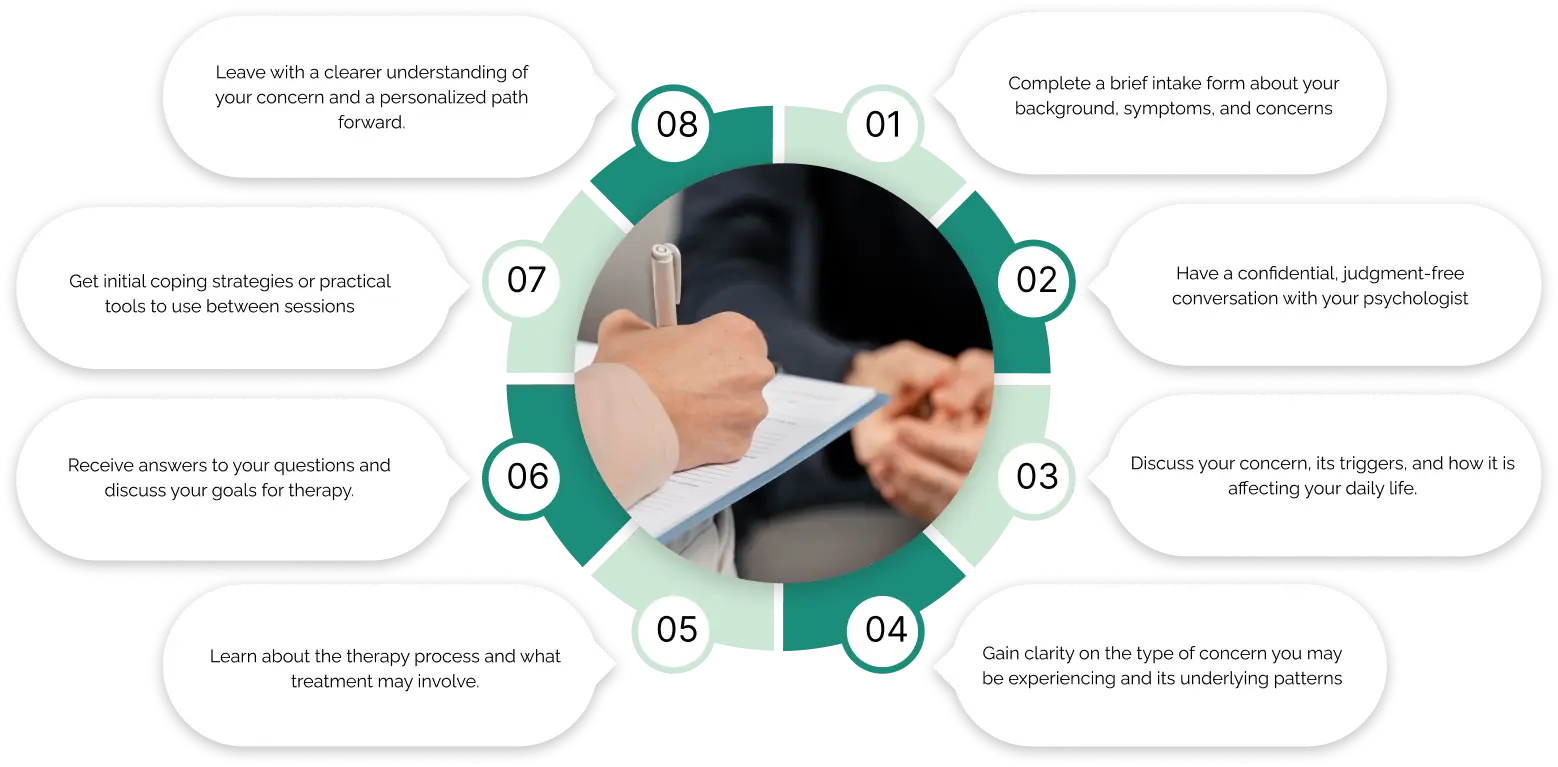
Reaching out for the first time can feel like a significant step. Here is exactly what happens. so, Here in autism spectrum disorder therapy this is what happens. no surprises.

If a full diagnostic assessment is recommended, your psychologist will walk you through the process, the timeline, and what the final report will include.
Both mode are clinically effective. Research consistently shows that online therapy produces outcomes equivalent to in-person therapy for your concerns. The best format is simply the one that makes it easiest for you to show up consistently.
Get informed and seek the right help in the right direction.
Students secretly suffer from anxiety, self-doubt, burnout, and emotional exhaustion owing to the feeling of not being ‘good enough’.
Screens are everywhere now. From online classes and cartoons to gaming and YouTube shorts.
A child psychologist is an expert in studying and assisting in the development of the emotional, behavioral, and cognitive growth of an individual.
Your concerns does not have to be the lens through which you experience everything. With the right support, you can understand what is driving it. It will help to loosen its hold on your decisions and relationships and reclaim a life that is not organised around avoidance and worry.