Home > Condition > Learning Difficulties

Learning Difficulties Therapy in Delhi. Specialist Support for Every Kind of Mind

Every child deserves the chance to thrive. When learning remains challenging despite effort, it may not be a matter of motivation or ability, but a sign that their brain processes information in a different way. At Kaleidoscope, our psychologists help you understand your child's unique learning needs and the support they need to succeed in academics and beyond.

Book 10 Mins Free Consultation

Is Your Child Struggling — or Simply Learning Differently?

As per the official definition by Learning Disabilities Association of Canada (LDAC), learning disabilities refer to a number of disorders which may affect the acquisition, organization, retention, understanding or use of verbal or nonverbal information.

These disorders affect learning in individuals who otherwise demonstrate age-appropriate abilities essential for thinking and/or reasoning.  As per the research published in Indian Journal of Psychological Medicine, learning disabilities affect approximately 1 in 12 children in India, yet most go unidentified for years.

Does My Child Have A Learning Difficulties? (Quick Self-Assessment)

Is there a significant gap between how well your child speaks and how they perform in writing or exams?

Are academic difficulties affecting their confidence, mood, or willingness to go to school?

Does your child read slowly, haltingly, or avoid reading aloud?

Does your child struggle with basic arithmetic despite repeated practice?

If you relate to two or more of these, a formal assessment may be the right next step.

The impact of a delayed diagnosis can reach far beyond the classroom. It can have an effect on self- esteem and confidence of a child while growing up. Recognizing these signs early can make a meaningful difference. If they sound familiar, it is time to seek reliable, professional support.

Signs Your Child May Have a Learning Difficulties

Learning disabilities can look different in every child. Some children struggle with reading, while others find it hard to organise their thoughts and express them. Here are some common signs to watch for

Reads Slowly, Haltingly, Or Avoids Reading Aloud

Frequently Confuses Similar Letters Such As B and D

Poor Spelling Despite Repeated Practice

Struggles To Understand Or Retain What They Have Just Read

Difficulty Rhyming Or Breaking Words Into Sounds

In case of emergency you can always reach out to 24/7 crisis helplines

Handwriting That Is Illegible Or Inconsistent

Difficulty Organising Thoughts Coherently On Paper

Avoids Writing Tasks Or Shows Visible Distress When Asked To Write

A Significant Gap Between Verbal Fluency and Written Expression

In case of emergency you can always reach out to 24/7 crisis helplines

Struggles With Basic Number Sense Or Counting

Loses Track Of Steps When Solving Multi-Step Problems

Cannot Recall Basic Arithmetic Facts Despite Practice

Confuses Mathematical Symbols Or Sequences

In case of emergency you can always reach out to 24/7 crisis helplines

Persistent Low Self-Esteem Linked To Academic Difficulties

Frustration, Meltdowns, Or School Refusal

Avoidance Of Activities Involving Reading, Writing, Or Numbers

Inconsistent Performance — Sometimes Excelling At Certain Subjects and Failing At Others With No Clear Pattern

In case of emergency you can always reach out to 24/7 crisis helplines

If many of these signs sound familiar, your child may be struggling with more than just schoolwork. The right support can make a lasting difference in your child's confidence, learning, and potential.

ADHD Help

When Does a Learning Difficulty Become Something That Needs Professional Help?

A Learning Disability becomes a clinical concern when it is

Persistent: Your child has been struggling for months or years, not just during a difficult term.

Disproportionate: The difficulty is significantly greater than what peers experience, despite similar instruction and effort.

Interfering: It is affecting school performance, confidence, or emotional wellbeing.

Unresponsive: Extra tutoring, practice, and encouragement have not closed the gap.

Escalating: The academic struggles are beginning to produce anxiety, avoidance, or a belief that they are simply not capable.

If you are noticing a pattern, seeking professional support shouldn’t be the last resort but the first step towards understanding your child’s unique needs.

What Are the Causes Behind Your Child's Learning Difficulty?

Every learning disability presents its own set of challenges and requires a different approach to support. Knowing which type your child has, is the starting point for effective treatment.

Genetic and Hereditary Factors

Learning disabilities often run in families, suggesting a strong genetic component and biological basis for certain learning difficulties.

Brain Development and Neurological Factors

Differences in brain development and information processing can affect reading, writing, attention, and mathematical skills.

Prenatal and Birth-Related Risks

Premature birth, low birth weight, pregnancy complications, or exposure to harmful substances during pregnancy may increase risk.

Environmental Factors

Exposure to toxins, limited early stimulation, or neglect can affect a child's cognitive and academic development.

Psychosocial and Emotional Trauma

Chronic stress, trauma, or unstable environments can interfere with concentration, memory, and learning.

Medical Conditions

Conditions such as ADHD, autism, epilepsy, hearing or vision difficulties, and sleep problems can impact learning and often occur alongside learning disabilities.

Book An Appointment

Book an online appointment for expert care anytime, anywhere.

Book 10 Mins Free Consultation

Types of Learning Difficulties

Not all learning difficulties are identical. Identifying the specific challenge is the first step towards giving your child the right support and with best chance to succeed.

Dyslexia

It affects reading and spelling due to difficulties processing the sounds that make up language. Children may be bright and articulate but struggle with reading fluency, decoding words, and spelling.

Dysgraphia

This condition affects written expression. Children may have messy handwriting, write very slowly, find it difficult to organise their thoughts on paper, or perform much better verbally than in writing.

Dyscalculia

It affects a child's understanding of numbers and mathematical concepts. They may struggle with counting, comparing quantities, recalling basic maths facts, or solving word problems.

Other Conditions

Other forms of learning disability include Language Processing Disorder, Non-Verbal Learning Disability (NVLD).

How Learning Difficulties Support Works at Kaleidoscope

Every child is unique, and so are their learning needs. That is why support for learning disabilities should be tailored to the individual child. At Kaleidoscope, we begin with a thorough understanding of how your child learns — their cognitive strengths, their specific nature of difficulties, and the emotional impact due to challenges. We then build a plan that is individual to them.

Our learning disability psychologist are trained in multiple evidence-based approaches. Depending on the profile that emerges from assessment, psychologist may draw on one or more of the following

Psychoeducational Assessment and Formal Diagnosis

The foundation of effective support is an accurate diagnosis. Our assessments evaluate cognitive functioning, academic achievement, language processing, memory, attention, and executive function using internationally validated tools.

The process includes an intake session, standardised testing, a detailed written report, and a debrief session to walk through findings in plain language.

Behavioural Therapy and Supportive Therapy for Learning Disabilities

Years of academic struggle leave emotional residue. Many children and adults with learning disabilities arrive carrying entrenched beliefs: I am not smart. There is no point trying.

Behavioural therapy and supportive therapy help identify and challenge these beliefs, build healthier responses to frustration and setbacks, and develop the psychological resilience that sustained progress requires. We work with both children and adults.

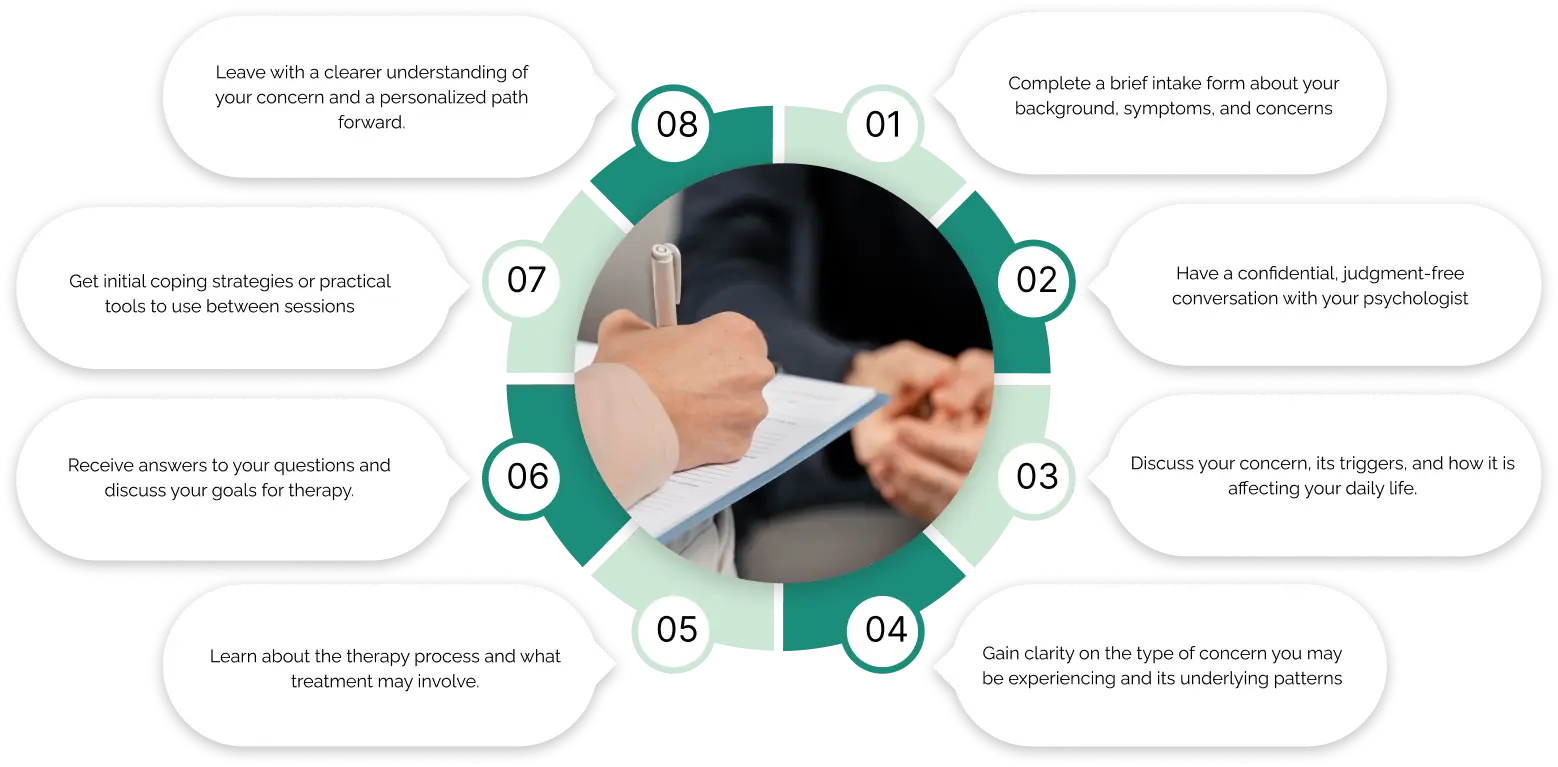
What to Expect in Your First Learning Difficulties Consultation at Kaleidoscope

Starting the process can feel like a big step, especially if you have been waiting a long time or are unsure what to expect. Here is exactly what happens, so there are no surprises.

For children, the process may include time with both parents and the child. After the session, your psychologist will explain the plan and any recommended next steps.

Online therapy for learning Difficulties and In-Clinic. Which Is Right for You?

Both mode are clinically effective. Research consistently shows that online therapy produces outcomes equivalent to in-person therapy for your concerns. The best format is simply the one that makes it easiest for you to show up consistently.

In-clinic therapy for learning Difficulty at our Rajendra Nagar centre in Delhi

Book In-Clinic Consultation

Online therapy for learning Difficulty offers Access from anywhere across the globe

Book Online Consultation

What Families Say About Learning Difficulty Support at Kaleidoscope

Frequently Asked Questions About Learning Difficulties Assessment and Therapy

There is a distinction between these two conditions. A slow learner usually finds most areas of learning challenging and progresses at a slower pace overall. In contrast, a child with a learning disability may do very well in some areas but struggle significantly in specific skills such as reading, writing, or mathematics. A psychological assessment can help identify the difference and determine the right support for your child.

Formal psychological assessments for learning disabilities are usually most accurate from around 6–7 years of age, when children have had enough exposure to reading and formal learning. However, concerns related to speech, language, motor skills, attention, or development can be identified much earlier, allowing children to receive support as soon as possible.

Yes. Research shows that the right interventions can make a significant difference for children with learning disabilities. Structured reading programmes have been proven to improve reading skills in children with dyslexia, while therapies such as behavioural therapy and supportive therapy can help build self-esteem, confidence, coping skills, and emotional resilience. With appropriate support, many children make meaningful progress both academically and emotionally.

Yes. Kaleidoscope offers online therapy, parent guidance, and learning support for children and families across India. For most concerns, sessions can be effectively conducted online from the comfort of your home. However, in cases involving learning disabilities, we recommend an in-person visit to Kaleidoscope or a nearby clinic for a formal assessment and therapy to ensure the most accurate evaluation and effective care.

Our Resources

Get Informed and Seek The Right Help In The Right Direction.

Family Pressure on Students
Mental Health

Family Pressure on Students, How It Affects Mental Health...

Students secretly suffer from anxiety, self-doubt, burnout, and emotional exhaustion owing to the feeling of not being ‘good enough’.

Admin
29 May 2026
Child using a smartphone at night in bed
Heart & cholesterol management

Screen Time and Mental Health in Children: How Much Is Too Much?

Screens are everywhere now. From online classes and cartoons to gaming and YouTube shorts.

Admin
25 May 2026
child psychologist is an expert in studying
Heart & cholesterol management

How to Choose the Right Child Psychologist for Your Child

A child psychologist is an expert in studying and assisting in the development of the emotional, behavioral, and cognitive growth of an individual.

Admin
20 May 2026

Start Your Journey to a Calmer Life Today

Your concerns does not have to be the lens through which you experience everything. With the right support, you can understand what is driving it. It will help to loosen its hold on your decisions and relationships and reclaim a life that is not organised around avoidance and worry.