Home > Condition > Schizophrenia

Schizophrenia Treatment in Delhi. Expert Psychological Support for You and Your Family

When unusual thoughts or behaviours begin to interfere with daily life, the uncertainty can feel overwhelming, leaving individuals and families confused. The right support can make a significant difference. Our psychologists at Kaleidoscope help individuals and families understand what is happening and build a more stable and meaningful life.

Book 10 Mins Free Consultation

Is Schizophrenia Affecting You or Someone You Love?

According to official definition by WHO ICD -11, Schizophrenia is characterised by disturbances in multiple mental modalities; including thinking, perception, self-experience, cognition, volition, affect, and behaviour. Persistent delusions, hallucinations, thought disorder, and experiences of passivity or control are considered core symptoms.

Do I Need Help? (Quick Self-Assessment)

Do you hold strong beliefs about being watched, followed, or having a special mission that others find hard to understand or accept?

Do you hear voices, sounds, or conversations that others around you cannot hear?

Has your motivation, emotional expression, or ability to manage daily life reduced significantly?

Do you find it difficult to organise your thoughts or communicate clearly?

If you relate to two or more of these, a professional assessment is the right next step

Everyone's experience of schizophrenia is different. For some, it begins with a gradual withdrawal from the world. For others, it arrives as a sudden, frightening break from reality. If your thoughts or emotions begin to feel overwhelming or interfere with your wellbeing, seeking professional help becomes an important step.

Signs You or a Loved One May Be Experiencing Schizophrenia

The early signs of schizophrenia can be subtle and are often mistaken for everyday stress or depression. Over time, these symptoms may become more noticeable. Common signs of schizophrenia include:

Hearing voices, sounds, or conversations that others don't hear

Holding firm beliefs about persecution, surveillance, or a special mission that don't respond to logic or reassurance

Seeing, smelling, or sensing things that are not there

Disorganised thinking or speech that makes it hard to follow a conversation

Racing thoughts or a sense that thoughts are being inserted, withdrawn, or broadcast to others

In case of emergency you can always reach out to 24/7 crisis helplines

Noticeably reduced facial expression or flat tone of voice

Loss of motivation, drive, or interest in previously enjoyable activities

Reduced speech and communication

Social withdrawal from family, friends, and familiar routines

Difficulty experiencing pleasure or emotional connection

In case of emergency you can always reach out to 24/7 crisis helplines

Difficulty concentrating or following through on tasks

Poor working memory and forgetfulness

Struggles with decision-making or planning

Difficulty processing information quickly

A general sense of mental fog or confusion

In case of emergency you can always reach out to 24/7 crisis helplines

If you recognise several of these symptoms in yourself or a loved one, early professional help can help you understand what is happening and identify the most appropriate steps you must take next.

Anxiety Help

When Does Schizophrenia Become Something That Needs Professional Help?

Professional support becomes essential when:

Distressing: Unusual beliefs or experiences are causing significant distress and are not fading over time.

Persistent: Symptoms have lasted weeks or months rather than days, or a previous episode has occurred.

Interfering: Daily functioning — work, relationships, self-care — has declined noticeably.

Escalating: Symptoms are intensifying, or there are signs of a crisis developing.

Affecting The Family: Carers and family members are struggling to cope, communicate, or understand what is happening.

If these experiences have become persistent or are beginning to affect daily life, seeking appropriate care can help bring clarity. The first step is understanding the nature of these experiences.

Understanding Schizophrenia. What Causes It?

Schizophrenia does not have a single cause. It often stems from a combination of factors. Hence, understanding the actual cause can help with accessing the right support.

Inherited Risk

Schizophrenia has a strong genetic component. If a close relative (like a parent or sibling) has the disorder, your risk is significantly higher. It is not caused by one specific gene, but rather a combination of hundreds of common gene variants that increase vulnerability.

Brain Chemistry

Imbalances in naturally occurring brain chemicals (neurotransmitters)— particularly dopamine and glutamate can affect how your brain cells communicate, which can lead to symptoms like hallucinations and delusions.

Brain Structure

Neuroimaging studies show structural differences in the central nervous systems of people with schizophrenia, suggesting that it has underlying neurobiological causes.

Childhood Adversity

Experiencing severe stress, trauma, or abuse during childhood increases a person's long-term vulnerability.

Substance Use

Frequent use of mind-altering or psychoactive substances (especially cannabis/marijuana, amphetamines, and LSD) during adolescence can trigger the onset of schizophrenia in individuals who are already at a higher genetic risk

Late-Onset

In some individuals, schizophrenia first emerges after the age of 40 and is more commonly seen in women. Late-onset cases are often associated with hormonal changes (such as declining estrogen levels after menopause), social isolation, sensory impairments like hearing loss, and a heightened genetic predisposition.

Book An Appointment

Book an online appointment for expert care anytime, anywhere.

Book 10 Mins Free Consultation
Types of Schizophrenia

Schizophrenia can affect people in different ways. Understanding these different types can help individuals and families make sense of their experiences and access required support.

Undifferentiated Schizophrenia

Includes a mix of symptoms from different forms of Schizophrenia, making it difficult to fit into one specific type.

Disorganised (Hebephrenic) Schizophrenia

It involves confused thinking, disorganised speech and behaviour, and difficulty expressing emotions appropriately.

Catatonic Schizophrenia

Causes noticeable changes in movement and behaviour, such as remaining still for long periods, speaking very little, or repeating certain words or actions.

Residual Schizophrenia

Occurs when severe symptoms have improved, but challenges such as low motivation, social withdrawal, or reduced emotional expression continue.

Paranoid Schizophrenia

This involves hallucinations and strong false beliefs, often centred around feeling suspicious of others or fearing harm. Thinking and speech may remain relatively clear.

Note: Most modern diagnostic manuals no longer formally classify schizophrenia into these subtypes. However, these terms are still commonly used to describe different symptom patterns and help people better understand the condition

How therapy for schizophrenia Works at Kaleidoscope

Psychological treatment is not a substitute for psychiatric medication. For most people with schizophrenia, antipsychotic medication remains central to symptom management. What we offer works alongside medication to help individuals understand their condition.

At Kaleidoscope, we begin by understanding the full picture symptom history, current functioning, and family circumstances. We build a plan around that. Our psychologists are trained in multiple evidence-based approaches. Your therapist may use one or more of the following, depending on your situation

Psychoeducation For Individuals and Families

Understanding schizophrenia—how symptoms change, what helps, and what doesn't—can significantly improve coping. For families, psychoeducation reduces confusion and blame while providing practical strategies. Research shows it can also reduce relapse rates.

Social Skills and Functional Rehabilitation

Schizophrenia can affect everyday skills such as communication, self-care, time management, and work or study functioning. Our psychologists help individuals rebuild routines, reconnect with daily life, and regain social confidence.

Relapse Prevention

Many people experience periods when symptoms worsen. We help identify early warning signs, develop crisis plans, and build strategies that reduce the impact and severity of future episodes.

Other Therapy Approaches

CBTp helps individuals explore their experiences, consider alternative perspectives, and reduce distress, while ACT focuses on changing one's relationship with distressing thoughts rather than eliminating them.

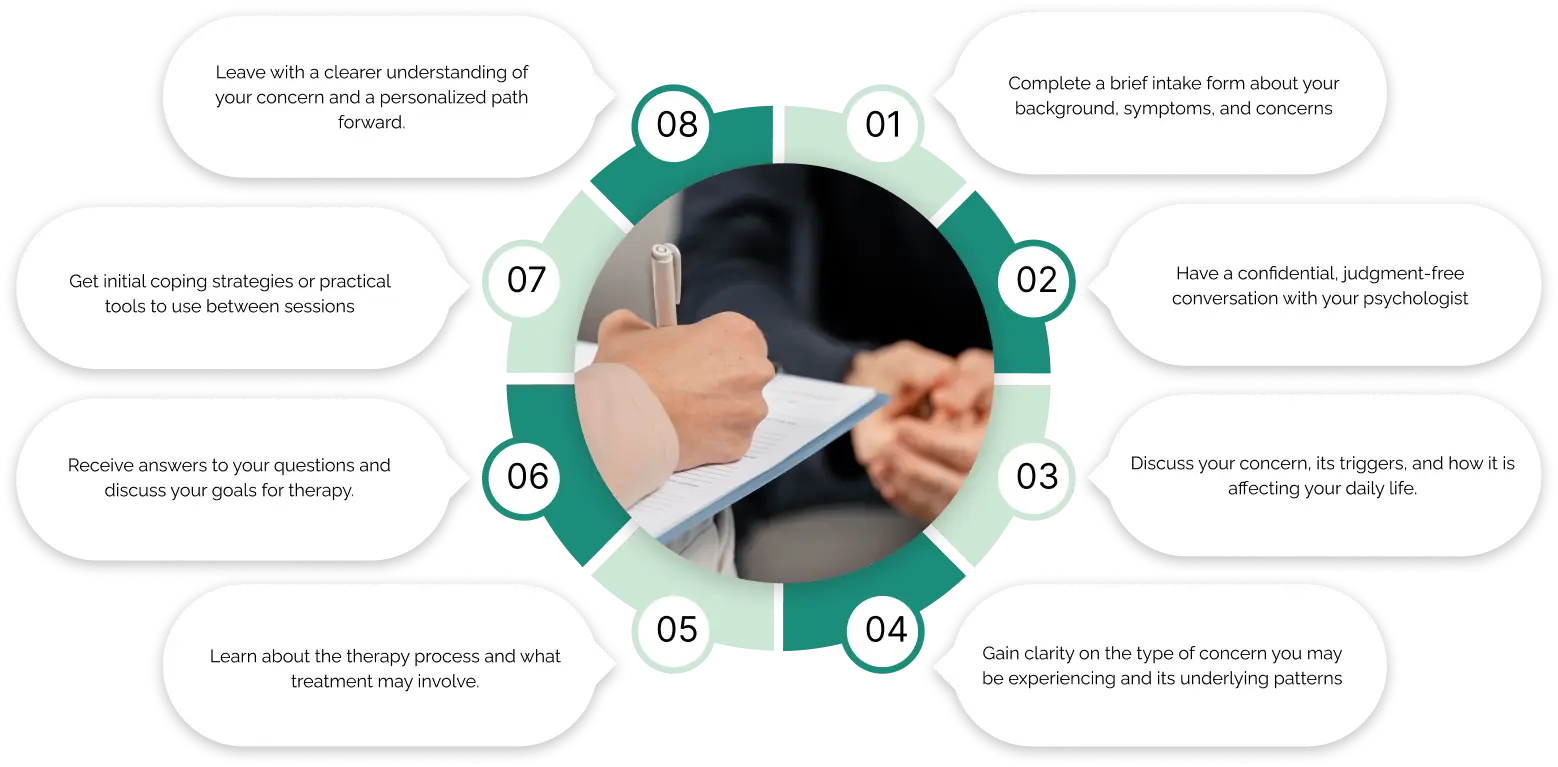
What to Expect in Your First Therapy for Schizophrenia Session

Starting therapy for schizophrenia can feel like a significant step, particularly when the condition involved is as complex as schizophrenia. Here is exactly what happens, so there are no surprises.

Progress in therapy is gradual. Your psychologist will not rush toward conclusions. The first sessions are about building the foundation for everything that follows.

Online therapy for Schizophrenia and In-Clinic. Which Is Right for You?

Both mode are clinically effective. Research consistently shows that online therapy produces outcomes equivalent to in-person therapy for your concerns. The best format is simply the one that makes it easiest for you to show up consistently.

In-clinic therapy for schizophrenia at our Rajendra Nagar centre in Delhi

Book In-Clinic Consultation

Online therapy for schizophrenia offers access from anywhere across the globe

Book Online Consultation

What Our Clients Say About Schizophrenia Support at Kaleidoscope

Frequently Asked Questions About Schizophrenia Treatment

While schizophrenia is not curable, it is manageable. With the right support, many people experience significant improvement in their symptoms and are able to lead stable, meaningful lives. Psychological therapy can help individuals better understand their experiences, develop coping skills, and improve daily functioning.

There is no fixed number of therapy sessions for schizophrenia. The length of support varies depending on a person's needs, symptoms, and goals. Some people benefit from short-term therapy, while others may need ongoing support over a longer period. During the initial sessions, we work together to understand your needs and develop a treatment plan that is realistic and helpful.

Schizoaffective disorder involves symptoms of both schizophrenia and a mood disorder, such as depression or bipolar disorder. Because the symptoms can overlap, it can sometimes be difficult to distinguish between these conditions. A thorough assessment helps ensure an accurate understanding of a person's experiences and the most appropriate support.

Kaleidoscope offers online therapy for individuals across India through secure and confidential video sessions. However, for concerns such as schizophrenia, we recommend an in-person visit to Kaleidoscope or a nearby clinic for a formal assessment and therapy to ensure the most accurate evaluation and effective care.

Our Resources

Get Informed and Seek The Right Help In The Right Direction.

Family Pressure on Students
Mental Health

Family Pressure on Students, How It Affects Mental Health...

Students secretly suffer from anxiety, self-doubt, burnout, and emotional exhaustion owing to the feeling of not being ‘good enough’.

Admin
29 May 2026
Child using a smartphone at night in bed
Heart & cholesterol management

Screen Time and Mental Health in Children: How Much Is Too Much?

Screens are everywhere now. From online classes and cartoons to gaming and YouTube shorts.

Admin
25 May 2026
child psychologist is an expert in studying
Heart & cholesterol management

How to Choose the Right Child Psychologist for Your Child

A child psychologist is an expert in studying and assisting in the development of the emotional, behavioral, and cognitive growth of an individual.

Admin
20 May 2026

Start Your Journey to a Calmer Life Today

Your concerns does not have to be the lens through which you experience everything. With the right support, you can understand what is driving it. It will help to loosen its hold on your decisions and relationships and reclaim a life that is not organised around avoidance and worry.