As per the World Health Organization, stress is defined as a state of worry or mental tension caused by a difficult situation. Stress is a natural human response that prompts us to address challenges and threats in our lives. Everyone experiences stress to some degree. The way we respond to stress, however, makes a big difference to our overall well-being.
When stress stops being a passing feeling and starts affecting how you sleep. It slowly affects how you think and how you show up in your relationships and at work; it becomes something that deserves professional attention.
Do you feel overwhelmed by daily responsibilities or work demands?
Do you find it difficult to switch off and relax, even during your free time?
Do you feel irritable, frustrated, or emotionally exhausted more often than usual?
Is stress affecting your sleep, focus, productivity, or relationships?
Many of us normalize living on high alert until our health or relationships suffer. Exploring these physical and emotional signs and symptoms of stress allows you to pause, check in with yourself, and seek the relief you deserve.
Persistent headaches, migraines, or tension in the neck and shoulders
Disrupted sleep, either falling asleep is hard, or you wake up feeling unrested
Fatigue that does not go away with rest
Frequent stomach issues, nausea, or changes in appetite
A racing heart, tightness in the chest, or shallow breathing
In case of emergency you can always reach out to 24/7 crisis helplines
Constant irritability or a short fuse over small things
Feeling anxious or overwhelmed
Low mood and reduced motivation
Negative thinking patterns or a sense of dread about the day ahead
Feeling detached or emotionally numb
In case of emergency you can always reach out to 24/7 crisis helplines
Withdrawing from people or activities you used to enjoy
Difficulty concentrating or making simple decisions
Procrastinating on tasks that feel impossible to start
Increased reliance on alcohol or other habits to cope
Snapping at people you care about, then feeling guilty
In case of emergency you can always reach out to 24/7 crisis helplines
If several of these feel familiar, stress may already be affecting your health. It is also affecting the quality of life in ways that go beyond what willpower or a holiday can fix.
Stress becomes a clinical concern when it is:
Disproportionate: Your body and mind respond as if every situation is an emergency
Persistent: it has lasted weeks or months rather than days
Interfering: It is affecting your work performance or physical health
Unmanageable: The usual things (exercise, rest, talking to a friend) do not help
Escalating: It is beginning to look or feel like anxiety, depression, or burnout
If stress has moved from occasional to constant, from inconvenience to disabling, professional support is not an overreaction. It is the right, rational step
Stress rarely comes from just one place; it accumulates quietly over time. Let’s look at the common roots and causes of stress together, not to label your struggles, but to help you find a clearer path toward relief and emotional balance.
Long hours and demanding managers. Sometimes, unclear expectations or simply doing work that no longer feels meaningful. Workplace stress is one of the most common reasons people seek therapy in Delhi.
Left unaddressed, it progresses into burnout. We help working professionals identify the specific stressors at play. We help them set sustainable boundaries and return to their work from a place of clarity rather than survival mode.
Conflict with a partner or strained communication with parents. The invisible weight of managing a household or relationship stress is often the hardest to talk about. It can leave you feeling guilty or deeply lonely, even when others surround you.
Our psychologists create a non-judgmental space to work through relationship patterns and improve communication.
For students in India, the pressure to perform is immense. They go through board exams and entrance tests. They also have to go through parental expectations and peer competition. This kind of high-stakes stress can trigger panic and complete avoidance of studying.
Kaleidoscopes work with school and college students to build emotional resilience and find perspective when pressure feels overwhelming.
Job loss or a business that is struggling. Money stress is among the most under-discussed forms of psychological distress. Similarly, major life transitions such as divorce, relocation, retirement, or the loss of a loved one can destabilise your sense of identity and safety.
Therapy does not fix your finances, but it does address the anxiety and hopelessness that financial and transitional stress produce. Hence, it helps in making it possible to think clearly and act strategically again.
Being diagnosed with a serious health condition or constantly fearing one. It creates a particular kind of stress that is exhausting and isolating. If you find yourself scanning your body for symptoms, avoiding doctors' visits out of fear. If you are consumed by worry about your health, health anxiety may be making your stress worse.
We offer specialised support for those managing the psychological burden of chronic illness. We also offer support for health-related worries and the uncertainty that comes with it.
Book an online appointment for expert care anytime, anywhere.
Not all stress is the same. Understanding which type you are experiencing helps us personalise your treatment:
Short-term stress in response to a specific event or pressure. Common and manageable, but distressing in the moment
Recurring bouts of acute stress. Often affects high-achievers or people who take on too much. Linked to irritability, anxiety, and tension headaches
Prolonged, unrelenting stress that the nervous system cannot reset from. Associated with serious health consequences. These include cardiovascular risk, immune suppression, and mental health conditions
A productive, motivating form of stress. This is the type that helps you meet deadlines and rise to challenges. Therapy helps you stay in this zone
Stress arising from a deeply distressing event. This may develop into post-traumatic stress disorder (PTSD) and require specialist care
Many people experience features of more than one type. A thorough assessment at Kaleidoscope will give you clarity on what you are dealing with and the most effective path forward.
There is no single way to treat stress. The reason is that no two people experience it the same way. At Kaleidoscope, we begin by understanding your specific stressors, your history, and your coping patterns. We will build a plan around you.
Our psychologists are trained in multiple evidence-based approaches. Depending on what is driving your stress, your therapist may draw on one or more of the following
CBT is one of the most extensively researched psychological treatments in the world. For stress, it works by helping you identify and challenge the thought patterns that amplify your stress response
In sessions, your therapist will work with you on practical strategies, behavioural experiments, activity scheduling, and structured problem-solving. CBT is particularly effective for work-related stress and stress tied to specific triggers
MBSR is a structured, evidence-based programme originally developed at the University of Massachusetts Medical School. It combines mindfulness meditation, body awareness, and yoga-inspired movement to help the nervous system shift out of a chronic stress state.
At Kaleidoscope, mindfulness-based techniques are integrated into individual therapy where appropriate, guided by your psychologist at a pace that works for you
ACT takes a different approach to stress: rather than trying to change or control stressful thoughts and feelings, it helps you change your relationship with them. Through psychological flexibility and committed action. ACT helps you stop fighting your internal experience and start building a life guided by what actually matters to you.
It builds psychological resilience rather than just symptom relief, and the skills you develop stay with you long after therapy ends.
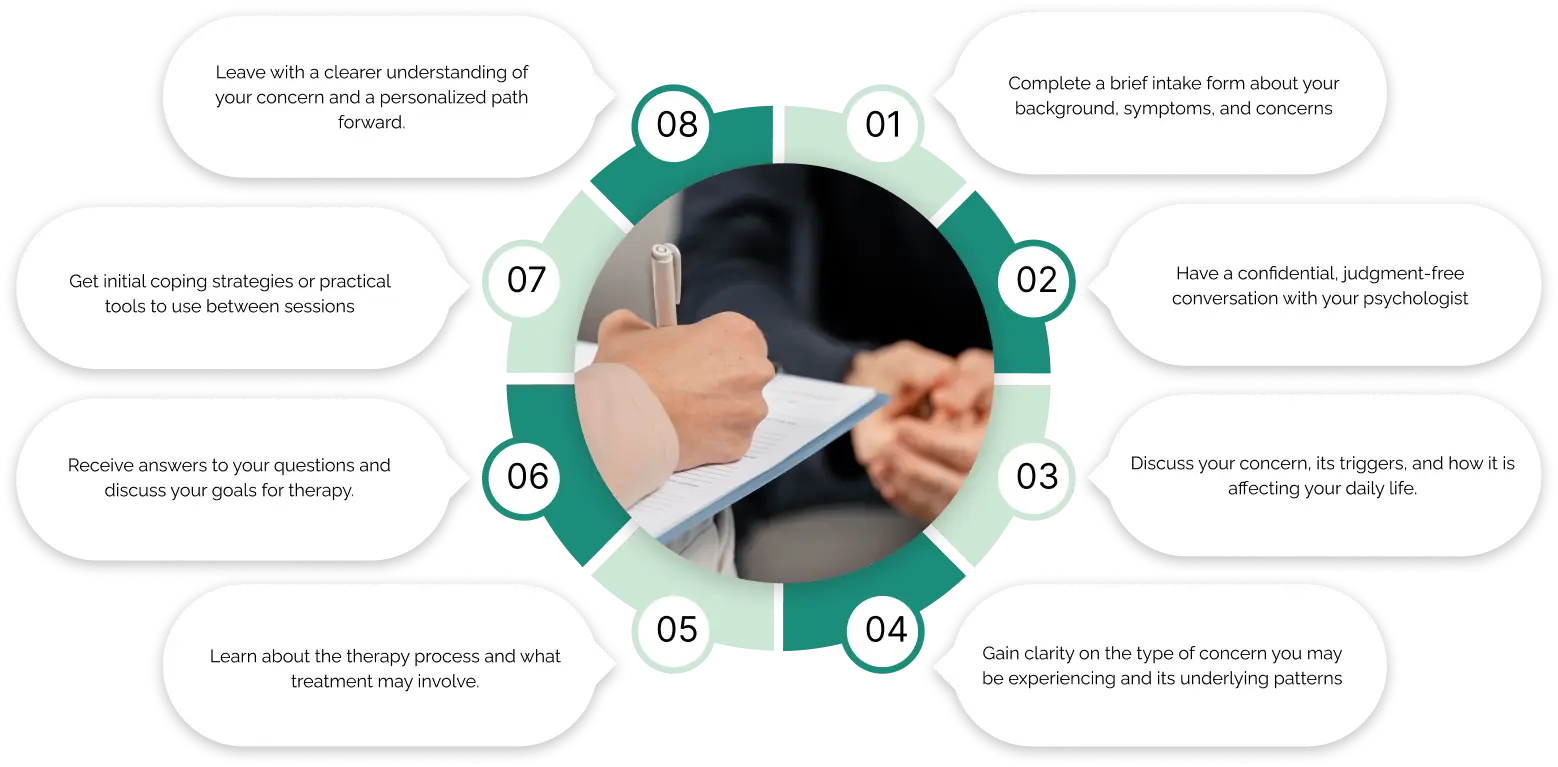
Starting therapy can feel like a big step, especially if you have never done it before. Here is exactly what happens, so there are no surprises

After the session, your psychologist may share some initial observations or simple techniques to try before your next appointment. Progress in therapy is gradual.
Both mode are clinically effective. Research consistently shows that online therapy produces outcomes equivalent to in-person therapy for your concerns. The best format is simply the one that makes it easiest for you to show up consistently.
Healed people express themselves from their hearts.
Your concerns does not have to be the lens through which you experience everything. With the right support, you can understand what is driving it. It will help to loosen its hold on your decisions and relationships and reclaim a life that is not organised around avoidance and worry.